
 Q. No.
A particle executes simple harmonic motion with amplitude \(A.\) It takes \(4~\text{s}\) to move from the negative extreme position \(-A\) to the position \(x=\dfrac{A}{2},\) moving toward the positive extreme. What is the time period \(T\) of its motion?
1. \(4\) s
2. \(8\) s
3. \(12\) s
4. \(18\) s
1. \(4\) s
2. \(8\) s
3. \(12\) s
4. \(18\) s


Two simple harmonic motions are represented by and . The ratio of their amplitudes is
1.
2.
3.
4.
A disc executes S.H.M. about the axis XX' in the plane of the disc as shown in the figure. Its time period of oscillation is:
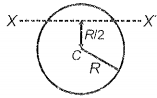
1.
2.
3.
4.


A spring-block system shown in the figure oscillates with a certain time period. If charge \(q\) is given to the block and a uniform field \(E\) is switched on, then its time period of oscillation is:

1. increases
2. decreases
3. may increase or decrease
4. remains the same
The period of oscillation of the spring block system shown in the figure is: (assume pulleys and spring to be ideal)
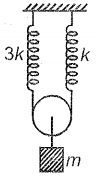
1.
2.
3.
4.
The graph between velocity and acceleration of a particle executing S.H.M. can be
1. A circle
2. An ellipse
3. A straight line
4. Both (1) & (2)


The potential energy of a particle of mass m executing SHM is given by U = A(1 - cos2x), where x is the instantaneous displacement of the particle. The time period of oscillation is
1.
2.
3.
4.
A uniform rod of length l is suspended at from one end and made to undergo small oscillations. The time period of oscillation is:
1.
2.
3.
4.
A simple pendulum with a metallic bob has a time period T. The bob is now immersed in a nonviscous liquid and the time period is found to be T. The ratio of the density of the metal to that of liquid is
1. 1/4
2. 4/3
3. 5/4
4. 7/3


1. \(T\)
2. \(2T\)
3. \(\dfrac{T}{2}\)
4. Infinite

© 2026 GoodEd Technologies Pvt. Ltd.