
 Q. No.
What is the correct order of reactivity of alcohols in the following reaction?
R-OH + HCl \( \xrightarrow[]{ZnCl_{2}}\) R-Cl + H2O
1. 1° > 2° > 3°
2. 1° < 2° > 3°
3. 3° > 2° > 1°
4. 3° > 1°> 2°


To unlock all the explanations of this course, you need to be enrolled.
To unlock all the explanations of this course, you need to be enrolled.

Match item in colum I with those in column II.
| Column I | Column II |
a.  |
i. 2-Ethoxypropane |
b.  |
ii.1-Ethoxy- 2-nitrocyclohexane |
c.  |
iii. 4-Chloro-2,3-dimethylpentan-1-ol |
d.  |
iv. 2,6-Dimethylphenol |
The correct option is-
1. a=ii; b=iii; c=i; d=iv
2. a=iii; b=iv; c=i; d=ii
3. a=iv; b=iii; c=i; d=ii
4. a=iii; b=i; c=iv; d=ii
To unlock all the explanations of this course, you need to be enrolled.
To unlock all the explanations of this course, you need to be enrolled.

1. 2-Isopropyl-3-methyl-5-pentanol.
2. 3-Isopropyl-3-methyl-1-butanol.
3. 2,3,4-Trimethyl-1-pentanol.
4. 3,4,5-Trimethyl-1-hexanol.


\(CH_3−CH=CH_2 \xrightarrow{H_2O/H^+}\) A
| 1. | CH3CH2CH2OH | 2. | CH3CH(OH)CH3 |
| 3. | CH3CH(OH)CH2OH | 4. | CH3CH2CH3 |
To unlock all the explanations of this course, you need to be enrolled.
To unlock all the explanations of this course, you need to be enrolled.
Which of the following is an example of elimination reaction?
1. Chlorination of methane
2. Dehydration of ethanol
3. Nitration of benzene
4. Hydroxylation of ethylene
| Column A | Column B | ||
| i. | Lucas' reagent | a. | Alkaline KMnO4 |
| ii. | Baeyer's reagent | b. | CH3MgBr |
| iii. | PCC | c. | ZnCl2+HCl |
| iv. | Grignard reagent | d. |  |
Choose the correct answer from the options given below:
1. i‐c, ii‐d, iii‐a, iv‐b
2. i‐b, ii‐c, iii‐a, iv‐d
3. i‐b, ii‐d, iii‐a, iv‐c
4. i‐c, ii‐a, iii‐d, iv‐b


1. HCHO
2. CH3OH
3. CO2
4. CH3COCH3
What is the IUPAC name of the given compound?
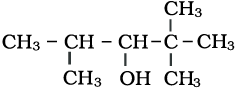
1. 2, 2, 2-Trimethylpentan-3-ol
2. 2, 2, 4-Trimethylpentan-3-ol
3. 2, 2, 3-Trimethylpentan-3-ol
4. 1, 1, 3-Trimethylpentan-3-ol
To unlock all the explanations of this course, you need to be enrolled.
To unlock all the explanations of this course, you need to be enrolled.
| Column I | Column II | ||
| Structural Formula | Compound Name | ||
| A. |  |
I. | Catechol |
| B. |  |
II. | Resorcinol |
| C. |  |
III. | Hydroquinone |
| D. |  |
IV. | o-Cresol |
| (A) | (B) | (C) | (D) | |
| 1. | (I) | (III) | (II) | (IV) |
| 2. | (III) | (I) | (II) | (IV) |
| 3. | (III) | (I) | (IV) | (II) |
| 4. | (I) | (III) | (IV) | (II) |


© 2026 GoodEd Technologies Pvt. Ltd.