
 Q. No.
1. solid sphere
2. hollow sphere
3. disc
4. ring


A solid cylinder of mass \(3\) kg is rolling on a horizontal surface with a velocity of \(4\) ms-1. It collides with a horizontal spring of force constant \(200\) Nm-1. The maximum compression produced in the spring will be:
1. \(0.5\) m
2. \(0.6\) m
3. \(0.7\) m
4. \(0.2\) m
P is the contact point of a wheel on the ground that rolls without slipping. The value of displacement of the point P, when the wheel completes half of the rotation (if the radius of the wheels is 1 m) is:
1. 2m
2.
3. m
4.


A solid sphere is rolling on a frictionless surface, as shown in the figure with a translational velocity of v m/s. If a sphere climbs up to a height h, then the value of v would be:

1.
2.
3.
4.
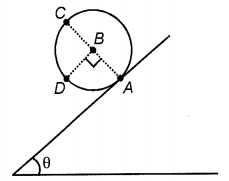
A disc is set in pure roll on an inclined plane. Let us take three points on the disc as shown in the figure. Then vB : vC : vD equals: (vB, vc and vD are corresponding speeds)
1.
2.
3.
4.
A string of negligible thickness is wrapped several times around a cylinder kept on a rough horizontal surface. A man standing at a distance l from the cylinder holds one end of the string and pulls the cylinder towards him. There is no slipping anywhere. The length of the string that passed through the hand of the man while the cylinder reaches his hands is-[Assume radius of the cylinder is negligible compared to length 'l' of string]

| 1. | l | 2. | 2l |
| 3. | 3l | 4. | 4l |


Choose the incorrect statement.
1. The centre of mass of a two-particle system lies on the line joining the two particles, being closer to the heavier particle.
2. In rolling, the point of contact of the rolling body remains at rest relative to the surface on which it is rolling.
3. The parallel axis theorem is applicable only for laminar bodies.
4. A particle moving on a straight line may have non-zero angular momentum about a point.
A disc hangs from an ideal string wrapped around it. If it is allowed to fall, the acceleration of the disc will be:

| 1. | \(g \) | 2. | \(\frac{g}{2} \) |
| 3. | \(\frac{2}{3} \) | 4. | \(\frac{2 g}{3}\) |
A hoop of radius \(2\) m weighs \(100\) kg. It rolls along a horizontal floor so that its center of mass has a speed of \(20\) cm/s. How much work has to be done to stop it?
1. \(10\) J
2. \(9\) J
3. \(4\) J
4. \(6\) J


A hollow sphere of mass m is rolling with a speed v on a smooth horizontal surface and strikes a massless spring of force constant k attached to a massless smooth platform. The maximum compression of the spring will be:

1.
2.
3.
4.

© 2026 GoodEd Technologies Pvt. Ltd.