- 1(current)
 Q. No.
Biotechnology is essentially:
| 1. | Manipulation of physical structures |
| 2. | Use of live organisms or enzymes for useful products and processes |
| 3. | Extraction of minerals from organisms |
| 4. | Creation of artificial intelligence |


Subtopic: Introduction & History |
95%
Level 1: 80%+
Please attempt this question first.
Hints
Please attempt this question first.

The definition given by EFB for biotechnology is
| 1. | Techniques of using live organisms only |
| 2. | Techniques of using enzymes only to produce products and processes useful to humans |
| 3. | The integration of natural science and organisms, cells, parts there of and molecular analogues for product and services |
| 4. | Techniques which include only synthesising a gene and using it |
Subtopic: Introduction & History |
89%
Level 1: 80%+
Please attempt this question first.
Hints
Please attempt this question first.
Which one of the following techniques made it possible to genetically engineer living organisms?
1. Recombinant DNA techniques
2. X-ray diffraction
3. Heavier isotope labeling
4. Hybridization
Subtopic: Introduction & History |
95%
Level 1: 80%+
Hints


A kind of biotechnology involving manipulation of DNA is:
1. DNA replication
2. genetic engineering
3. denaturation
4. renaturation
Subtopic: Introduction & History | Tools |
85%
Level 1: 80%+
Please attempt this question first.
Hints
Please attempt this question first.
Traditional hybridisation procedure used in plant and animal breeding:
| 1. | is not useful in production of improved variants. |
| 2. | preserves the genetic information in populations. |
| 3. | is a very fast process to produce large number of progeny in a very short time. |
| 4. | very often leads to inclusion and multiplication of undesirable genes along with the desired genes. |
Subtopic: Introduction & History |
84%
Level 1: 80%+
Please attempt this question first.
Hints
Please attempt this question first.
What is true A,B and C in the given diagrammatic representation of rDNA technology ?
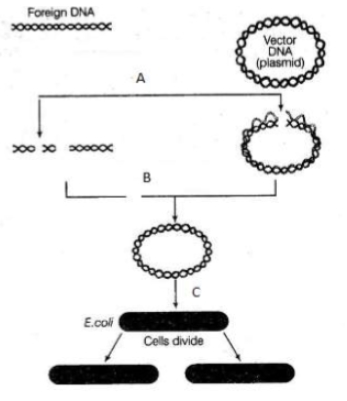
| I: | At A same restriction enzyme is used to cut both foreign and vector DNA |
| II: | The enzyme used at B is DNA ligase |
| III: | Step C can be called as transformation |
| 1. | I and II only |
| 2. | I and III only |
| 3. | II and III only |
| 4. | I,II and III |
Subtopic: Introduction & History: II | Tools: Enzymes: I | Introduction & History | Tools |
87%
Level 1: 80%+
Hints
Links


Match Column-I with Column-II and select the correct option:
1. a(iii), b(i), c(ii), d(iv)
2. a(i), b(ii), c(iii), d(iv)
3. a(iii), b(iv), c(i), d(ii)
4. a(iii), b(iv), c(ii), d(i)
| Column-I | Column-II | ||
| a. | Restriction endonuclease | (i) | Hind II |
| b. | First recombinant DNA | (ii) | Obtained from strain RY13 |
| c. | First restriction endonuclease | (iii) | Isolated in 1963 |
| d. | EcoRI | (iv) | Developed in 1972 |
1. a(iii), b(i), c(ii), d(iv)
2. a(i), b(ii), c(iii), d(iv)
3. a(iii), b(iv), c(i), d(ii)
4. a(iii), b(iv), c(ii), d(i)
Subtopic: Restriction Enzymes: Historical Background | Introduction & History |
81%
Level 1: 80%+
Hints
Isolation of genetic material from fungal cells involves the use of
1. Lysozyme
2. Cellulase
3. Chitinase
4. Polymerase
1. Lysozyme
2. Cellulase
3. Chitinase
4. Polymerase
Subtopic: Introduction & History: I | Introduction & History: II | Process of Biotech | Introduction & History |
89%
Level 1: 80%+
Please attempt this question first.
Hints
Please attempt this question first.
Which of the following is needed to extract DNA from tomato cells?
1. DNase
2. Lysozyme
3. Cellulase
4. Chitinase
1. DNase
2. Lysozyme
3. Cellulase
4. Chitinase
Subtopic: Host & Desired DNA | Introduction & History | Tools |
75%
Level 2: 60%+
Please attempt this question first.
Hints
Please attempt this question first.


Proteases are added during DNA isolation to:
1. Digest cell wall
2. Remove proteins bound to DNA
3. Break DNA molecules
4. Activate other enzymes
1. Digest cell wall
2. Remove proteins bound to DNA
3. Break DNA molecules
4. Activate other enzymes
Subtopic: Introduction & History |
87%
Level 1: 80%+
Please attempt this question first.
Hints
Please attempt this question first.
- 1(current)
Q. No.
© 2026 GoodEd Technologies Pvt. Ltd.