 Magnetism and Matter Part 2: Earth's Magnetism & Magnetic MaterialsContact Number: 8527521718Magnetism and Matter Part 2: Earth's Magnetism & Magnetic MaterialsContact Number: 8527521718
The dipole moment of each molecule of a paramagnetic gas is \(1.5\times10^{-23}~A-m^{2}.\) The temperature of the gas is and the number of molecules per unit volume in it are \(2\times10^{26}~m^{-3}.\) The maximum possible intensity of magnetization in the gas will be:
1. \(3\times10^{3}~A/m\)
2. \(4\times10^{-3}~A/m\)
3. \(5\times10^{5}~A/m\)
4. \(6\times10^{-4}~A/m\)
Electromagnets are made of soft iron because soft iron has:
1. low retentivity and high coercive force
2. high retentivity and high coercive force
3. low retentivity and low coercive force
4. high retentivity and low coercive force
The current of 30 A is flowing in a vertical straight wire. If the horizontal component of the earth's magnetic field is 2 x 10⁻⁵ Tesla, then the position of the null point will be:
1. 0.9 m
2. 0.3 mm
3. 0.3 cm
4. 0.3 m
A frog can be levitated in a magnetic field produced by a current in a vertical solenoid placed below the frog. This is possible because the body of the frog behaves as:
| 1. | Paramagnetic | 2. | Diamagnetic |
| 3. | Ferromagnetic | 4. | None of these |
The vertical component of the earth's magnetic field is zero at:
1. The magnetic poles.
2. The magnetic equator.
3. The geographic poles.
4. The geographic equator.
The liquid in the watch glass in the following figure is:
1. Ferromagnetic
2. Paramagnetic
3. Diamagnetic
4. Nonmagnetic
The relation amongst the three elements of Earth's magnetic field, namely horizontal component H, vertical component V and dip angle is: (=total magnetic field):
1. V=tan, H=
2. V=sin, H=cos
3. V=cos, H=sin
4. V=, H=tan
A bar magnet has coercivity \(4\times 10^{3}~\text{Am}^{-1}\). It is desired to demagnetize it by inserting it inside a solenoid \(12~\text{cm}\) long and having \(60\) turns. The current that should be sent through the solenoid is:
1. \(2\) A
2. \(4\) A
3. \(6\) A
4. \(8\) A
A uniform magnetic field, parallel to the plane of the paper existed in space initially directed from left to right. When a bar of soft iron is placed in the field parallel to it, the lines of force passing through it will be represented by:
| 1. |  |
2. |  |
| 3. |  |
4. |  |
The variation of the intensity of magnetization (I) with respect to the magnetizing field (H) in a diamagnetic substance is described by which graph in the figure?
1. OD
2. OC
3. OB
4. OA
The magnetic dipoles in a diamagnetic material are represented, for three situations. The three situations differ in magnitude if a magnetic field is applied to the material. In which situation the magnetization of the material is the greatest:

| 1. | \(A\) | 2. | \(B\) |
| 3. | \(C\) | 4. | Equal in \(A,B\) and \(C\) |
Elements of Earth's magnetism is/are
1. Magnetic declination
2. Magnetic Inclination (or dip)
3. The horizontal component of the earth's magnetic field
4. All of these
Choose the correct statement regarding magnetism.
| 1. | Paramagnetic sample displays greater magnetization when cooled. |
| 2. | Diamagnetism is almost independent of temperature. |
| 3. | Ferromagnetic substances show hysteresis. |
| 4. | All of these. |
Magnetic susceptibility of the given paramagnetic substance at room temperature is:
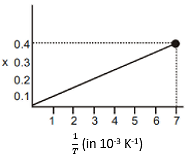
1. 2.8 ×
2. 57
3. 0.19
4. 0.57
A magnetic needle free to rotate in a vertical plane parallel to the magnetic meridian has its north tip pointing down at 22° with the horizontal. The horizontal component of the earth’s magnetic field at the place is known to be 0.35 G. The magnitude of the earth’s magnetic field at the place is:
1. 0.377 G
2. 0.278 G
3. 0.027 G
4. 0.101 G
A Rowland ring of mean radius \(15\) cm has \(3500\) turns of wire wound on a ferromagnetic core of relative permeability \(800.\) What is the magnetic field \(B\) in the core for a magnetizing current of \(1.2\) A?
1. \(3.27\) T
2. \(2.56\) T
3. \(1.05\) T
4. \(4.48\) T
An iron rod of susceptibility \(599\) is subjected to a magnetizing field of \(1200~\text{Am}^{-1}.\) The permeability of the material of the rod is:
\(( \mu_0=4\pi\times 10^{-7}~\text{TmA}^{-1})\)
1. \(8 . 0 \times10^{- 5 }~\text{TmA}^{- 1}\)
2. \(2 . 4 \pi \times10^{- 5 }~\text{TmA}^{- 1}\)
3. \(2 . 4 \pi \times10^{- 7 }~\text{TmA}^{- 1}\)
4. \(2 . 4 \pi \times10^{- 4 }~\text{TmA}^{- 1}\)
Diamagnetic material in a magnetic field moves:
| 1. | from stronger to the weaker parts of the field |
| 2. | from weaker to the stronger parts of the field |
| 3. | perpendicular to the field |
| 4. | in none of the above directions |
The earth’s magnetic field at the equator is approximately 0.4 G. The earth’s dipole moment is:
(Radius of earth, \(R_{E}=6.4\times10^{6} \) m)
1. \(1.05\times10^{23}\) A-m2
2. \(8.0\times10^{22}\) A-m2
3. \(4.5\times10^{23}\) A-m2
4. \(2.10\times10^{23}\) A-m2
A solenoid has a core of material with relative permeability \(400\). The windings of the solenoid are insulated from the core and carry a current of \(2~\text{A}\). If the number of turns is \(1000\) per metre, the magnetization, \(M\) is:
| 1. | \(8\times10^{5}~\text{A/m}\) | 2. | \(6\times10^{5}~\text{A/m}\) |
| 3. | \(6.5\times10^{5}~\text{A/m}\) | 4. | \(8.9\times10^{5}~\text{A/m}\) |

