
 Q. No.
A pendulum is hung from the roof of a sufficiently high building and is moving freely to and fro like a simple harmonic oscillator. The acceleration of the bob of the pendulum is \(20\text{ m/s}^2\) at a distance of \(5\text{ m}\) from the mean position. The time period of oscillation is:
1. \(2\pi \text{ s}\)
2. \(\pi \text{ s}\)
3. \(2 \text{ s}\)
4. \(1 \text{ s}\)
1. \(2\pi \text{ s}\)
2. \(\pi \text{ s}\)
3. \(2 \text{ s}\)
4. \(1 \text{ s}\)


A particle is executing a simple harmonic motion. Its maximum acceleration is \(\alpha\) and maximum velocity is \(\beta.\) Then its time period of vibration will be:
1. \(\dfrac {\beta^2}{\alpha^2}\)
2. \(\dfrac {\beta}{\alpha}\)
3. \(\dfrac {\beta^2}{\alpha}\)
4. \(\dfrac {2\pi \beta}{\alpha}\)
A particle is executing SHM along a straight line. Its velocities at distances \(x_1\) and \(x_2\) from the mean position are \(v_1\) and \(v_2\), respectively. Its time period is:
| 1. | \(2 \pi \sqrt{\dfrac{x_{1}^{2}+x_{2}^{2}}{v_{1}^{2}+v_{2}^{2}}}~\) | 2. | \(2 \pi \sqrt{\dfrac{{x}_{2}^{2}-{x}_{1}^{2}}{{v}_{1}^{2}-{v}_{2}^{2}}}\) |
| 3. | \(2 \pi \sqrt{\dfrac{v_{1}^{2}+v_{2}^{2}}{x_{1}^{2}+x_{2}^{2}}}\) | 4. | \(2 \pi \sqrt{\dfrac{v_{1}^{2}-v_{2}^{2}}{x_{1}^{2}-x_{2}^{2}}}\) |


The oscillation of a body on a smooth horizontal surface is represented by the equation, \(X=A \text{cos}(\omega t)\),
where \(X=\) displacement at time \(t,\) \(\omega=\) frequency of oscillation.
Which one of the following graphs correctly shows the variation of acceleration, \(a\) with time, \(t?\)
(\(T=\) time period)
| 1. |  |
2. |  |
| 3. |  |
4. |  |
1. Only (IV) does not represent SHM
2. (I) and (III)
3. (I) and (II)
4. Only (I)

A particle of mass \(m\) is released from rest and follows a parabolic path as shown. Assuming that the displacement of the mass from the origin is small, which graph correctly depicts the position of the particle as a function of time?

| 1. |  |
2. |  |
| 3. | 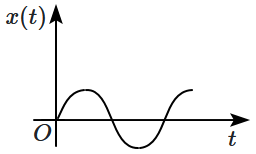 |
4. |  |


1. \(\frac{\pi a\sqrt3}{2T}\)
2. \(\frac{\pi a}{T}\)
3. \(\frac{3\pi^2 a}{T}\)
4. \(\frac{\pi a\sqrt3}{T}\)
1. Acceleration = -k0x + k1x2
2. Acceleration = -k(x+a)
3. Acceleration = k(x+a)
4. Acceleration = kx
1. 1: 10
2. 1: 102
3. 1: 103
4. 1: 104


Two points are located at a distance of \(10\) m and \(15\) m from the source of oscillation. The period of oscillation is \(0.05\) s and the velocity of the wave is \(300\) m/s. What is the phase difference between the oscillations of two points?
1. \(\frac{\pi}{3}\)
2. \(\frac{2\pi}{3}\)
3. \(\pi\)
4. \(\frac{\pi}{6}\)

© 2025 GoodEd Technologies Pvt. Ltd.